
Montgomery Summit 2026: Reporting Back, from the Conference Floor.
‘Monty’ - the premier annual invitation-only event for tech entrepreneurs, investors, & executives,running since 2004,
I attended the renowned Montgomery Summit ‘26 in Santa Monica this month, convened by March Capital. With ‘Monty’ running since 2004, it’s an attractor for entrepreneurs, investors, and leaders to attend a curated, invitation-only event… and it was pleasing to see a significant amount of Aussies in attendance this year.
From a Merton Lawyers standpoint, we’ve put a lot of work into our relationships in the USA, and the annual Monty visit is important in a number of ways - namely solidifying long-standing relationships, and creating new ones.
It’s all about relationships in the work we do creating pathways for technology startups to connect into some of the top law firms in America, and we’re extremely happy with the runs on the board we’ve notched up to now with our Project Frontier.
I made sure to take notes and photos of the experience to report back. See below, and please do reach out if you want to hear more of the experience - I highly recommend finding a way to Monty in the near future!
— Anthony Merton, Co-Founder Merton Lawyers.
The Montgomery Summit
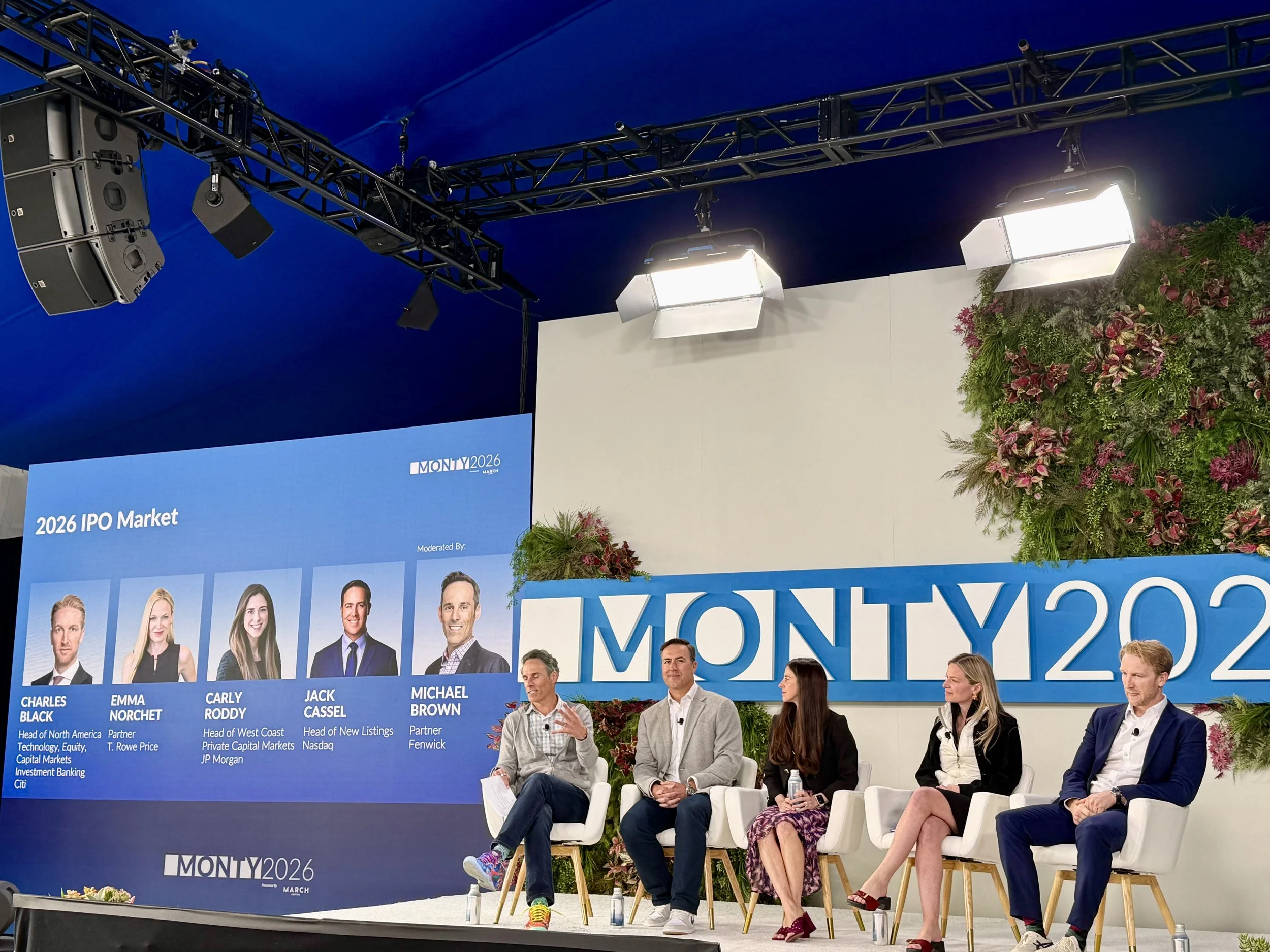
Charles Black (Citi) leading the ‘2026 IPO Market’ Discussion at Monty
The Montgomery Summit has always been one of those rooms where the conversations happening in the corridors are as valuable as the ones on stage, and this year was of course no different. (some major sporting events occurring in Australia in 2026 helped with the getting-to-know-you’s too)
Across a packed program of panels and keynotes, a handful of themes kept surfacing - on AI of course, energy transition, IPOs, and what it takes to build something enduring.
AI, Leadership & Speed Change
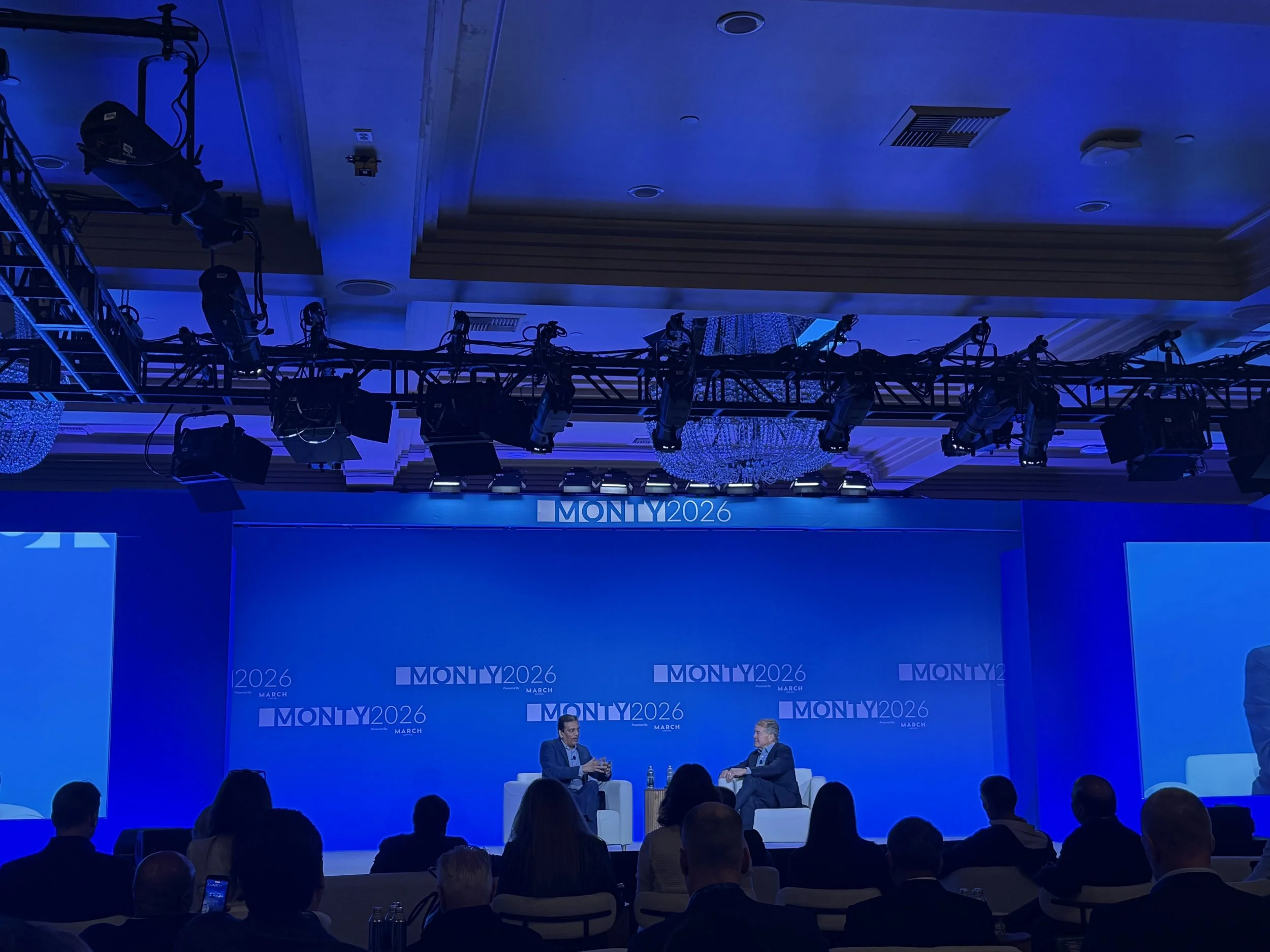
(L-R) Raj Subramaniam, CEO of FedEx, in conversation with John Chambers, Founder & CEO of JC2 Ventures
One of the standout sessions for me was an early one. Raj Subramaniam, CEO of FedEx, was sharp, direct, and worth quoting: his internal message to staff on navigating AI-driven change "You can either not like change, but you'll hate extinction" - landed as one of the more memorable lines of the Summit.
Raj continued to focus on FedEx’s approach to empowering their people with AI tools to drive real, measurable results in the business, operationalising at scale as a result.
John Chambers - Founder & CEO of JC2 Ventures - joined the program and reinforced a theme that ran through much of the Summit: the pace of building has fundamentally shifted.
The old startup playbook - 2 years in development, 3 years to hit $1M in revenue, 4-5 years to reach $5M - is being compressed dramatically. That same journey now looks more like a weekend for development, two quarters to $1M, and 12-18 months to $5M. The speed of change was reiterated time and again.
The numbers behind this aren't anecdotal. US productivity, which sat at around 1.2x pre-AI, has already moved to 1.7x. The ambition being discussed in these rooms is soon to push that to 5x.
And the time it takes a company to reach IPO-ready scale, which has historically sat at around 15 years, is now tracking closer to 7. OpenAI reaching 100 million users in a month was held up as a marker of just how different this moment we’re in is.
You only need look at the ARR growth for OpenAI and Anthropic in just a few short recent months: astronomical.
Powering the Revolution: AI and Energy Infrastructure
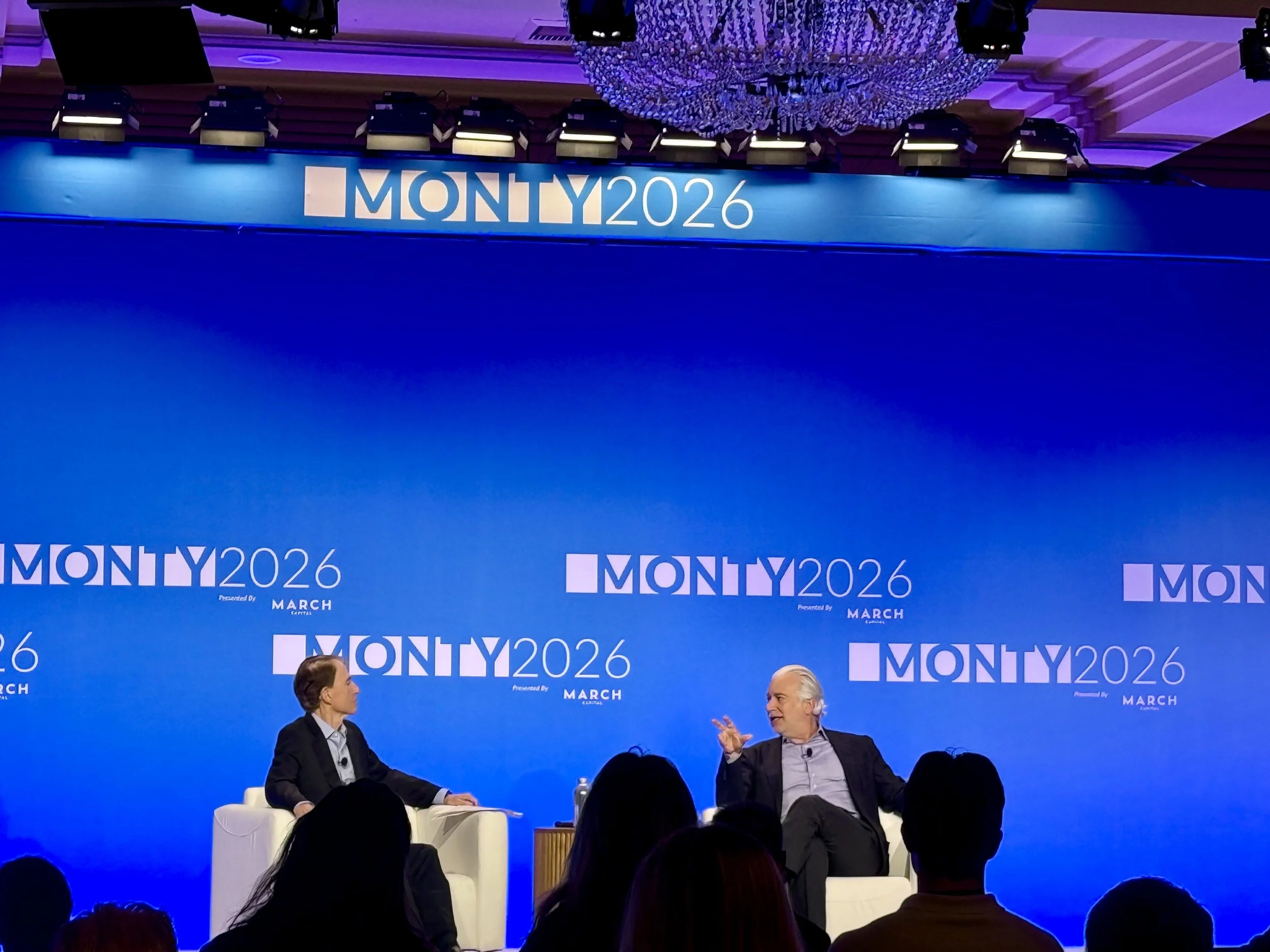
(L-R) Steve Westly (fmr State Controller of California) in conversation with Daniel Weiss of Angeleno Group
Daniel Weiss of Angeleno Group and former State Controller of California Steve Westly presented on what is quietly becoming one of the defining investment conversations of the decade: where is all the power going to come from?
The headline figure (it’s a big one) is that the world will need approximately 10 times the electrons generated over the past 25 years, then delivered over the next 15 years, just to keep pace with powering AI and data centre demand.
That demand is coming from everywhere. BYD, who are now producing $18,000 cars, were cited as one example of how electrification is accelerating the pressure from multiple directions simultaneously.
Daniel Weiss outlined where he sees the opportunity: grid enhancement, smarter transmission lines, and minimising line loss are near-term plays. But the bigger conversation is around efficiency gains within existing infrastructure, not just building new capacity.
One Australian company that got a namecheck during the discussion: IND Technology, a Melbourne-based firm that Angeleno Group has invested in, were held up as an example of the kind of grid efficiency work attracting serious capital.
The Waymo data point was striking: just under half of the power needed to run a Waymo vehicle is dedicated to the vehicle's battery. The majority of the remainder flows out to data centre power.
The IPO Market: Open, Shut, and Everything In Between
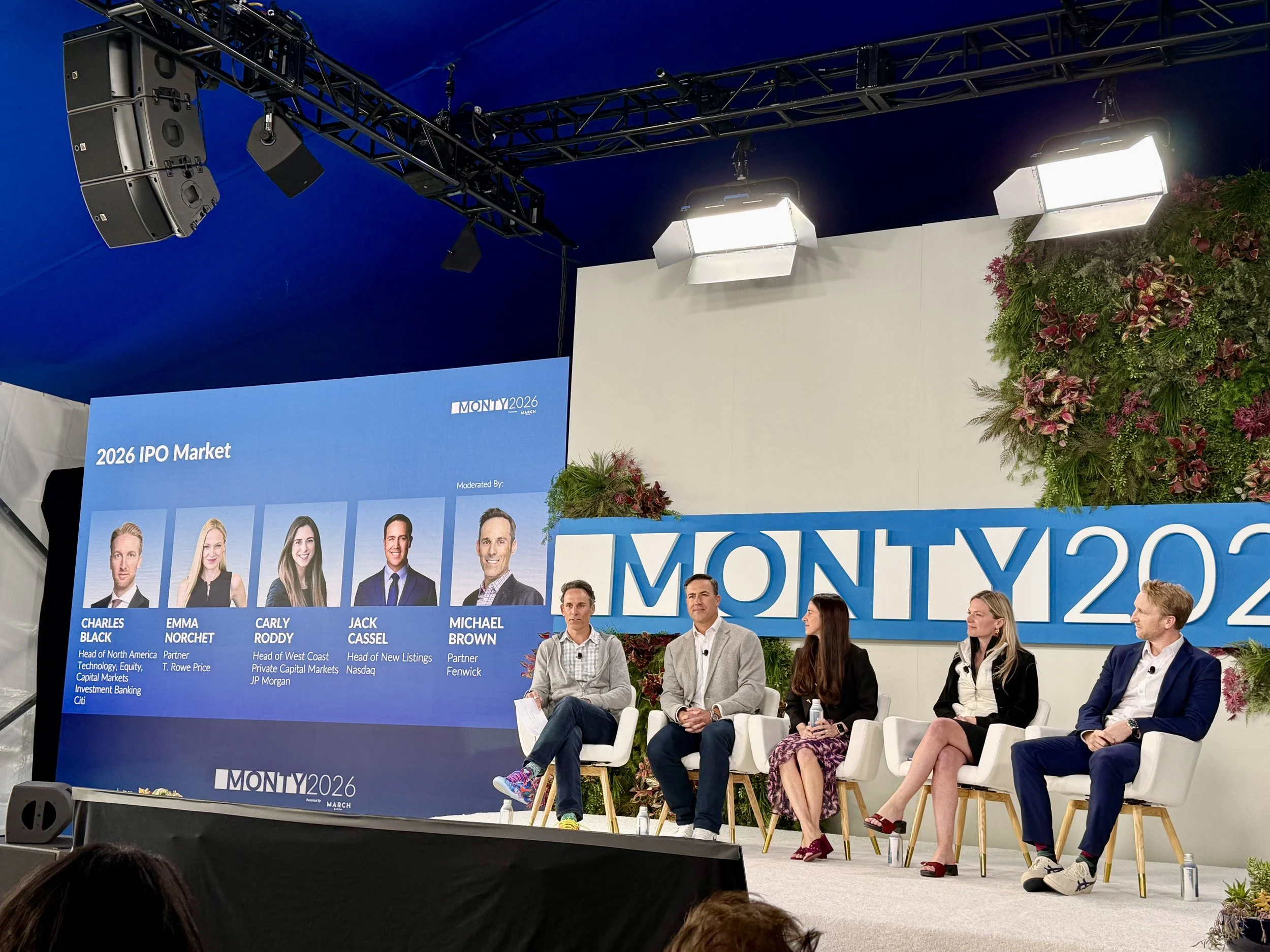
(L-R) Michael Brown (Fenwick) Jack Cassel (Nasdaq) Carly Roddy (JP Morgan) Emma Norchet (T.Rowe Price) Charles Black (Citi)
Charles Black (representing Australia, and a participant on the 2025 Merton Lawyers Startup Board Course) led what I thought to be one of the more substantive sessions, an honest look at where the IPO market sits in 2026.
The numbers tell part of the story: there were 10 tech IPOs in 2024. In 2025, that jumped to 24. The window is more open than it was, but the conditions have shifted.
Charles - who is head of Nth America Tech, Equity, Capital Markets & Investment Banking at Citi - held this highly interesting conversation with an extremely high quality panel:
Michael Brown (Partner at Fenwick) Jack Cassel (Head of New Listings at Nasdaq) Carly Roddy (Head of West Coast Private Capital Markets at JP Morgan) & Emma Norchet (Partner at T.Rowe Price)
What investors want now is straightforward, even if it's not easy to deliver: durable growth and underlying financials that hold up under scrutiny. Companies that may have stumbled early when they first contemplated going public have largely used the intervening period to reassess, recalibrate, and sharpen their story.
The "open and shut" nature of the IPO market was a recurring phrase in Charles' session - the idea that windows open and close, and timing your readiness to meet one is as much a discipline as a strategy.
Perhaps the most interesting structural observation was the evolution from a dual-track question (IPO or sale) to a ‘triple track’: stay private, pursue IPO, or sell. All three are now treated as legitimate, context-dependent outcomes rather than a hierarchy with IPO at the top.
*Note - This is something Merton Lawyers have been tracking closely, recently referenced in my LinkedIn post about the IPO market behaviour in Aus, related to an Age/SMH article I contributed to . The triple-track framing aligns with the analysis we've been developing for Australian founders thinking about their US expansion timelines. It was genuinely interesting to see that same framing show up independently in these conversations.
California: Private Capital Stepping In
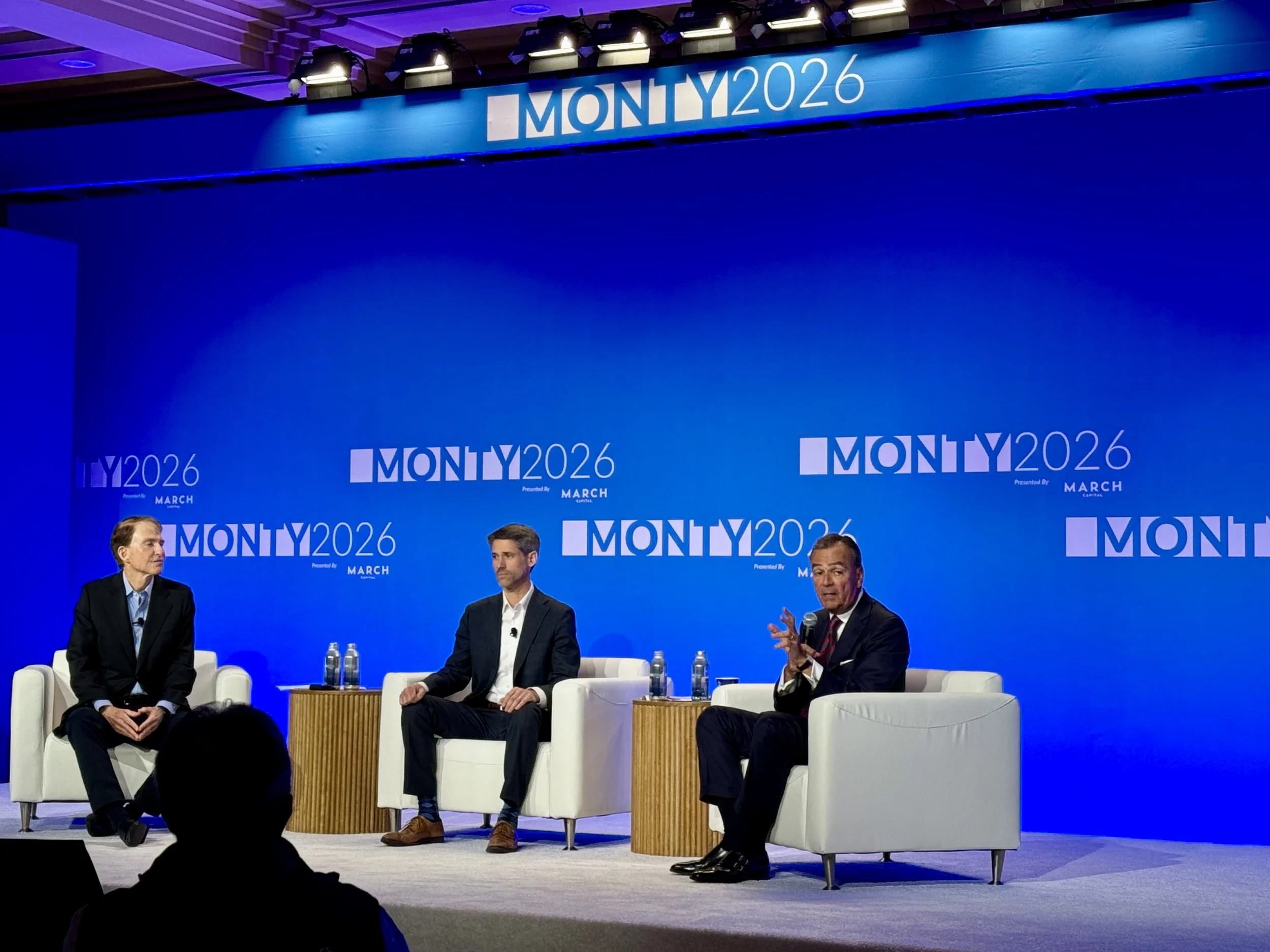
(L-R) Steve Westly (The Westly Group) Matt Mahan (Mayor of San Jose) Rick Caruso (Caruso Group)
One session which offered a different lens was focused not on markets, but on place. The California panel - which included Mayor of San Jose Matt Mahan (who’ll run for California Governor), Rick Caruso (Founder of Real Estate Company Caruso) and Steve Westly (The Westly Group) - explored how the state is navigating a period of significant economic and political pressure.
What stood out was the emergence of private individuals building their own economic initiatives independently of government.
Rick Caruso and Steve Westly were both cited as prime examples of people who’ve gone out and created private programs to support the California economy, which is symbolic of how the relationship between private capital and public outcomes is shifting.
Matt Mahan's focus on government accountability, and on measuring performance across education, energy, and infrastructure, added a different dimension to the conversation.
One genuinely unexpected takeaway: a school called Alpha, which has been generating quiet interest in education circles, operates on a model where students are physically present for roughly two days in total, complemented by a curriculum focused on real-world skills. By most measures, students are performing exceptionally well. It's an early signal of how dramatically learning models may shift.
The broader goal of the California session: making the state a destination for new investment and talent, at a moment when that's not a given.
What It Means From Here

The Summit presented a broad narrative rather than a singular one, but to me, that was the appealing aspect, with threads connecting and narratives colliding:
AI is compressing timelines
Energy is a constraint nobody has fully solved
The IPO market is recovering but demanding
Private Capital is increasingly filling gaps that institutions and governments are leaving open.
For Australian founders and investors watching the US market, the message is less about any single data point and more about the pace of change. The gap between what's being discussed in these rooms and what reaches Australian shores has always had a lag. And that lag is now getting shorter.
— AC. Follow me on LinkedIn HERE
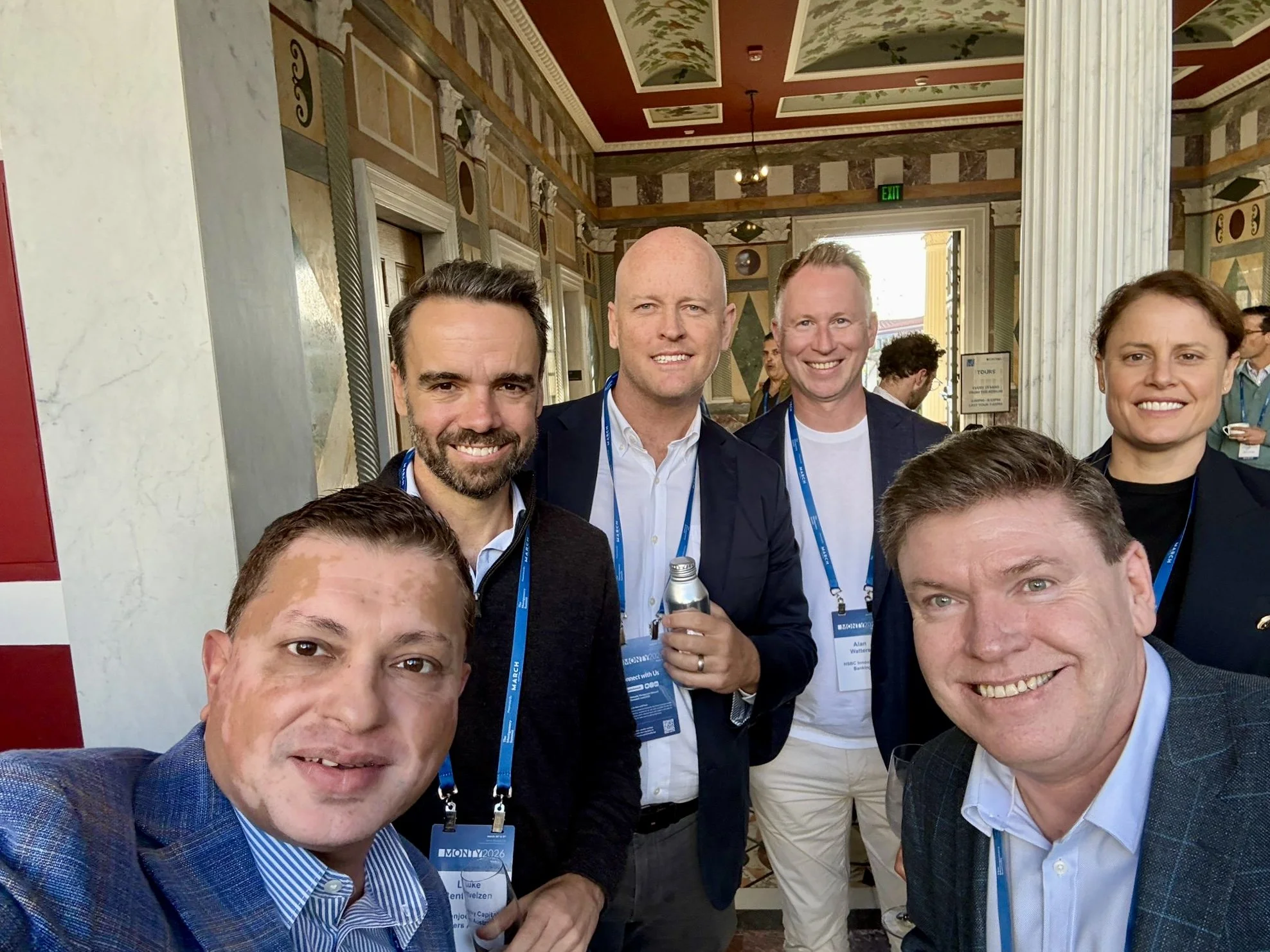
(L-R) Amit Verma (ASX) Luke Bentvelzen (Barrenjoey) Anthony Curtin (Merton Lawyers) Alan Watters (HSBC) David Ryan (DLA Piper) Kelly Morrison (DLA Piper)